

Description
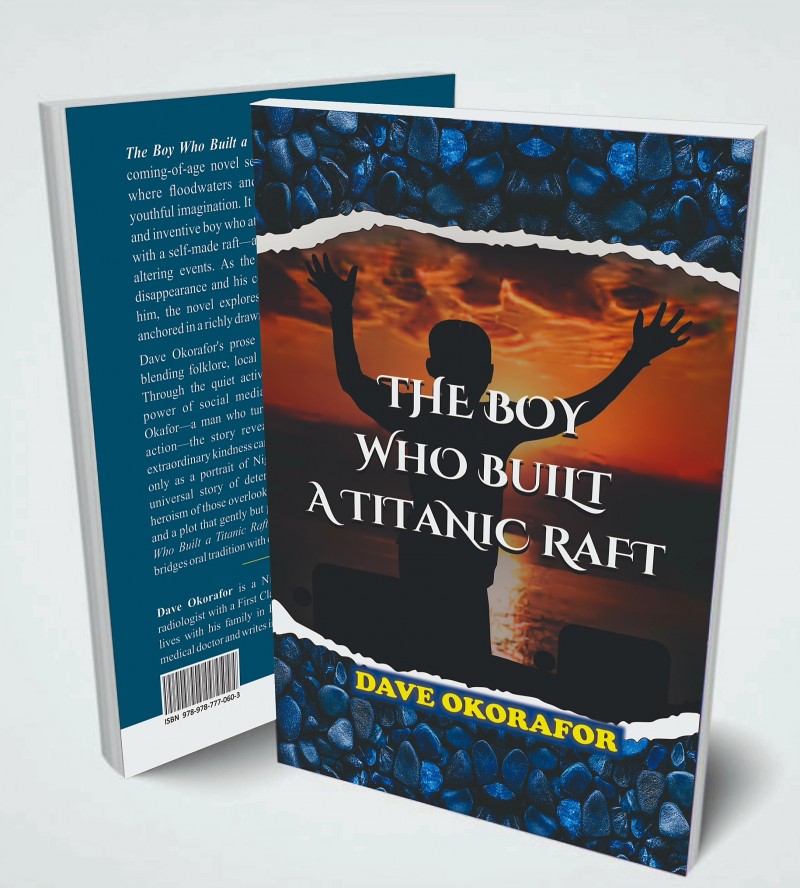
The Boy Who Built a Titanic Raft is a deeply moving coming-of-age novel set in the Nigerian town of Igah, where floodwaters and broken systems collide with youthful imagination. It tells the story of Icheku, a spirited and inventive boy who attempts to cross a collapsed bridge by building a raft—an act that sets off a series of life-altering events. As the story unfolds through Icheku’s disappearance and his community’s desperate search for him, the novel explores grief, faith, and resilience, all anchored in a richly drawn cultural landscape.
Dave Okorafor’s prose is warm, witty, and observant, blending folklore, local dialect, and modern challenges. Through the quiet activism of Gloria, the unexpected power of social media, and the humility of Chief Okafor—a man who turns digital noise into real-world action—the story reveals how ordinary people and extraordinary kindness can shape fate. The novel shines not only as a portrait of Nigerian childhood but also as a universal story of determination, loss, and the quiet heroism of those overlooked. With characters that feel real and a plot that gently but powerfully crescendos, The Boy Who Built a Titanic Raft stands as a literary work that bridges oral tradition with contemporary storytelling
Chineme –
A RIVETING NARRATIVE!
“The Boy Who Built a Titanic Raft” is a remarkably poignant and ultimately captivating tale that masterfully weaves a heartfelt narrative around a compelling protagonist, Icheku, who is a blend of youthful naivety and fierce determination. Icheku’s ambitious yet ill-fated attempt to cross a collapsed bridge on a self-made raft spirals into a gripping tale of survival, community, and resilience.
The novel beautifully captures the essence of human spirit, excelling in its exploration of several thought-provoking themes about the power of human ingenuity, the unpredictability of fate, community and resilience. The tragicomic tone underscores the absurdity of human ambition when pitted against nature’s unpredictability, yet it celebrates the courage to dream big.
The novel’s emotional authenticity and thematic richness elevate it above standard coming-of-age narratives. It is an engaging story that lingers, reminding readers of the fragility of dreams, the strength found in human connection and the enduring resilience that binds us all.
Dave Okorafor’s prose is evocative yet accessible, with vivid descriptions.The dialogue is authentic, capturing the cadence of rural life, the raw emotions of its inhabitants and the emotional weight of the characters’ relationships.
Dave Okorafor’s writing style is engaging, and the narrative is well-paced, keeping the reader invested in the protagonist’s journey.
“The Boy Who Built a Titanic Raft” is an interesting novel that will resonate with readers of all ages.
~ Chineme Mayfair Akpangene
Aikay Joearmstrong –
“The Boy Who Built The Titanic Raft” is not your regular novel. In fact, it’s a brilliantly layered work of “edutainment” that teaches as it entertains. Each page is intentionally crafted to subtly nudge you to learn, unlearn, and relearn. The author doesn’t just tell a story; he enriches your vocabulary, throwing in new words and demonstrating how to use them correctly within context. It’s brilliant without being too forward.
Now, the storytelling: Very engaging. The characters are not just relatable. They’re familiar. From their names to their mannerisms and the world they inhabit, you’ll feel like you know them personally. And that’s part of the book’s strengths. Dr. Dave did a fantastic job developing both the plot and the people in it. Nothing felt forced. The pacing? Smooth. The dialogue? Natural. You won’t struggle to follow the story, and yet, it’ll keep you flipping through.
But here’s what really stood out for me: the bold reflection of our society. The book takes a hard, honest look at the rising tide of voodooism and how these so-called “men of gods” and spiritual con artists have evolved from the Nollywood stereotype of “drop the money inside this calabash” to “swipe your card for consultation with the gods.”
That transition alone was chilling and funny in equal measure.
There’s also a very sobering commentary on how we’ve slowly become spectators to human suffering, with particular emphasis on filming tragedies instead of helping. Everyone’s now an emergency journalist or instant content creator, chasing likes and followers off the pain of others. That bit hit hard. Seems like social media is gradually eroding our sense of empathy, and the book captures that truth with exacting clarity.
Even the ego-driven narratives and deliberate misinformation that now dominate online spaces were captured with finesse. I particularly liked how the author balanced the criticism with a reminder that social media can still be a powerful force for good, if only we choose to use it right.
And then there was Engr. Okafor; wealthy, generous, yet profoundly humble. His contrast with the likes of Hon. Jafa Jafa (what a name) couldn’t be more glaring. One gives from the heart; the other milks every kind act for clout. We’ve all seen a Jafa Jafa in real life.
In all, the book is not just a good read. It’s an important one. It entertains, yes, but it also calls you to think, to reflect, and maybe even to grow.
Well done, Dr. Dave Okorafor. And a big thank you to Engr. @Benison Ovoke for the thoughtful gift.
“The Boy Who Built The Titanic Raft” is definitely one of those books I’ll be recommending for a long time.
M. Ehimen Iyere –
It’s just a boy, his raft, and his dreams!
It’s a masterpiece!
M. Ehimen Iyere –
It’s just a boy, his raft, and his dreams.
THE BOY WHO BUILT A TITANIC RAFT – by Dave Okorafor
A coming of age realistic fiction, rural life, modernity, and full of adventures, set in Igah, a community in Kogi state.
—
The first thing in this book that drew me into its wonder cave was the title – It carries a strong weight. The book cover has a boy on his raft, waving his arms. From the very first page, the words pulled me in, making it clear this isn’t just a regular novel—it is an immortal tale that everybody should read.
—
Icheku is a young boy with impressive smartness. Being an intelligent and curious child, and with the level of maturity he displays for his age, there’s a level of confidence and care his parents has shown towards him in the course of the book. With his determination and resilience, he represents the many young people out there who remain strong-willed despite the present economy and discouraging environment.
His friend Agbonika is a friend indeed. Icheku wouldn’t have found the dangerous courage to set his titanic to sail if not for the final hailing of his best friend. Even when Agbonika didn’t understand or couldn’t make sense out of Icheku’s determination, he supported still, hoping everything would work out in their favours. His curiousity, sense of humor and occasional fear balance Icheku’s courage. Friends like Agbonika are not found everywhere. Also, friends like Mr. Okpanachi to Mr. Azubuike.
Mr. & Mrs. Azubuike have shown in the book, to be supportive parents, great couple, and understanding people. In the midst of the chaos, they had their down moments, yet, they held still, focusing on the safety of their son. While his father revealed an overprotective character willing to spend more than he has in consulting priests and native doctors who would help with spiritual communications for his son’s safety -his mother appeared too faith driven and totally believing in God to protect and bring her son back
There’s Reverend Joseph, the Onu, and most strikingly, Menene the madman whose part was played not to cast humour as it was expected, but to cast fear of what may or may not. Mrs. Ali’s constant calls and past experience Ije has had with her, had set the whole music for the dance at the onset, but at the end, we realise Mrs. Ali was just a woman with motherly heart too.
—
Engr. Okafor and Gloria are very important characters worthy of note, Gloria is the catalyst who moved the rescue from a local stream search into an organised river search after bringing Icheku into spotlight. Without her help, Okafor wouldn’t have been able to take any notice of the boy. Engr. Okafor being a humble man, far from what Azubuike expected him to look like, appeared with very simple outfit, regular car, no bodyguards and most interestingly blended with the others. One can hardly differentiate him from his driver, makes me think of one of the person many of us must known by now, (Olajide Abiola)
The fact that Engr. Okafor and other well meaning Nigerians had learnt or would learn about the broken bridge, something would be done. The news got wings and flew across the country through the power of the internet.
Both Honourable Jafa Jafa and Ideke remain the characters representing pretentious leaders and quack local diviners. Hon. Jafa Jafa makes me think of our currently celebrated Governor Amuneke (Kelvin Black) whose social media comedy skit has many truths about our dear political economy hidden inside them. With leaders like him, what would become of the broken bridge at Ero Stream, because I know that Hon. Jafa Jafa was only bluffing, but if I were him, I would push for the reconstruction of the bridge.
The most hilarious moment was when Okpanachi and Azubuike had to buy a goat double the price because the yahoo boys has made the price of white rams too expensive, they also had to present the ram to Ideke’s P.A who added it to the other white rams in his master’s animal shed, hahaha and told them to deposit an outrageous amount at the cashier’s desk, take a waiting card and wait in the waiting room. 😂
—
The story hit without hitting, the absurdity and sad truth about the state of desperation for power, quick money and spiritual fortifications among people especially the youths of today, revealing how they’d do anything to get what they want. Take the heap of people on the line waiting to see Ideke the digital native doctor who has a cashier, a P.A, an office and a laptop to communicate with the gods and the spirit. 😂
(And also tell me why a woman who has such money to buy white ram and pay to see Ideke to help her charm men for their money, when she has same opportunity to ask for such money for herself instead. Haha.)
Chiedu, Idowu and Kufre also came towards the end of the book to teach readers how to take calculative actions, place a level of logical reasonings before emotions, and also how to be resilient. If you study Kufre very well, you’ll learn more than that.
The kidnappers or prospective kidnappers reveal how desperate many people are for money, it’s a sad tale of struggling Nigerians eager to make other struggling Nigerians suffer so they can survive.
—
Another outstanding thing about the book is how the writer has made conversations between characters so seamlessly natural and revealing. His reader could easily find themselves in the midst of a discussion between Icheku and Agbonika, Mr. Okpanachi and Mr. Azubuike, the Onu and his community people etc
I remember as a curious secondary school girl, I would read books hoping to find new words, despite understanding what the words meant, I still hurriedly search for the meaning in my Oxford dictionary, eager to use them in my next conversation with classmates, that is the same thing I felt while reading The Boy Who Built A Titanic Raft. The writer had casually and intentionally introduced concepts like fluoride, buoyancy, etc. His young readers are learning new words and also enjoying the adventure of a dreamer boy.
It also reveals modernity, how despite the small community where a local boy has grew, he had watched or heard about the movie Titanic and that has fueled his imaginations and his desire to build his own titanic. This shows us that movies and books has a strong way of influencing readers and listeners.
—
The story has an engaging hook, it was right there at the begining of the book…of a boy adrift on a raft.
I don’t know whether to see the book as fiction or not. Icheku seems real, like one of the little boys I know in the neighborhood, like one of the young boys I see everyday making crowns out of trashes. Dave Okorafor vividly described Igah, the Ero Stream, Igala culture, and the authentic feel of people living in the community. There’s the inclusion of local dialects, the use of Nigerian pidgin, to accommodate a broader audience and maintain authenticity.
It’s amazing how a book like this could blend adventure, culture, humour and mystery so well. It’s a promising read for young adults, the consistent suspense was needed for a masterpiece.
—
Dave Okorafor’s prose blends the rural life with modernity in today’s Nigeria. The sensory details immerse the reader in the sights, sounds, and textures of rural life, the power of the internet, the length people would go to get what they are looking, and the spirit of brotherhood and community, all woven into a book without confusing the reader.
—
I wouldn’t know whether to call it the writer’s own flaw or carelessness from Icheku’s family. But a heavy downpour the previous night in a community where, for an errands of 20minutes under normal circumstances took a mother about 4 hours to realise something was not right. Being relaxed initially was simply because of assumptions that Icheku should be with his friend Agbonika or headed to the football match, but that is never enough for the instinct of an African mother.
Again, I thought of his father, and dared to ask myself if the story would have taken same path if there was no single donations from concerned social media viewers, if his actions towards his wife would have been the same towards the end. I mean, this man started being soft on his wife just when the first millions hit his account. Before then, it was pointing fingers, blaming her for their son’s misfortune, as it was the custom of many African fathers. But far from that, Mr. Azubuike is naturally an understanding father as described by the author.
For its satisfying emotional conclusion, the book has passed.
A boy like Icheku who has announced that he would build another raft, a better Titanic.
This is a boy who believed in himself before others would. What didn’t kill him made him stronger, in faith, in his courage, his dream. This is a lesson for all of us.
—
The Boy Who Built A Titanic Raft is a powerful book that would leave readers learning, laughing, wondering, imagining, and gasping until the very last page. With its strong potential for classroom use and general readership, this is not just a novel, it is an immortal tale which would waft across the ears of the children of the future, when elders would tell them in quiet evenings. The book is immortal, Young readers, school students, and elders who find comfort and joy in books will find themselves right at home with this one.
Rating: ⭐⭐⭐⭐⭐ (5/5)
-M. Ehimen Iyere
Chimezie Princewill Okezie –
“The small raft drifted like a lost leaf upon the restless waters of the Omambala River, with young Icheku sprawled weakly across it. Five relentless days of whipping winds and three more of merciless rain battering him— yet, the boy and his Titanic clung together, just like the stubborn devotion of a caterpillar holding firm to its leaf”.
The above paragraph is my paraphrased version of the prologue of the book, ‘THE BOY WHO BUILT A TITANIC RAFT!’.
About a week ago, I started reading this masterpiece by Dr. Dave Okorafor, and from the very first page, I was hooked!
One of the first things that struck me was just how relatable the book feels, especially for those of us living in the southern part of Nigeria. The setting is familiar, the cultural undertones are authentic, and the use of native names anchors the story deeply in our soil.
At its heart, the book tells the story of Icheku, a young boy whose courage, quick thinking, and raw ingenuity would change the fortunes of his family.
It all begins one seemingly ordinary morning when his mother, Mrs. Azubuike, wakes him up with a simple errand to deliver a box of cake to a customer, Mrs Ali, on the other side of the village.
But that morning’s journey takes an unexpected turn.
Heavy rains from the previous night have washed away the only long-aged bridge connecting their village to Odega, the neighboring community. Standing at the riverbank, Icheku faces a choice: turn back and disappoint his mother, or find another way. It is in that moment that the seed of an idea is planted. The idea that will later bore the historic “Titanic Raft.”
With his friend Agbonika by his side, Icheku sets to work, piecing together a vessel from bamboos, jerrycans, ropes, and whatever scraps they can find. At first, the raft’s mission is simple — deliver the cake and get back safely. But as word spreads, a second purpose emerges: charging market women and villagers a small fee to ferry them across the river. What began as an emergency improvisation becomes a micro-enterprise.
Then comes the twist. While paddling on the stream, the raft runs into trouble and had Icheku swept away by the mysterious Ero stream. A waterway whispered about in fearful tones, because, as local lore warns, no one has ever swum across and lived to tell the tale.
From here, the story widens to reveal more than just Icheku’s personal journey. We meet Honourable Jafa-Jafa, a former feared tout at the Igah Motor Park, now a federal lawmaker, and a walking symbol of Nigeria’s political rot and corruption. In a scene that is as satirical as it is scathing, Jafa-Jafa gives Icheku’s father, Mr. Azubuike, an envelope containing a mere twenty thousand naira. Days later, the same man is on the news and social media boasting about “sending relief supplies to flood victims” and “mobilizing efforts to rescue the missing boy,” using the envelope handover photo, of which he edited with Artificial intelligence (AI) as his headline image.
It’s impossible to read that chapter without recalling the real-life antics of trending comedian Kevinblak, popularly known by his comic series character as “Governor Amuneke,” whose skits parody the same kind of shallow political grandstanding. Dr. Okoroafor manages to capture the absurdity of such moments without losing sight of their sting.
Another strength of the book is how it captures the power and double-edged nature of the social media. It is through the internet that the family and community learn where Icheku is. It is through viral posts by one Ada Otuocha and others, that the rescue mission gains traction. And it is through online generosity that millions of naira in the tone of over fifteen million naira pour in to support the Azubuike family.
What makes The Boy Who Built a Titanic Raft so refreshing is that it is not just a tale of survival. It is a layered narrative about resilience, power of the internet, political hypocrisy, and the entrepreneurial spirit that can bloom in the most unlikely of places.
Dr. Dave Okoroafor writes with a storyteller’s rhythm, painting scenes that are vivid yet unforced. His characters feel like people you’ve met before — perhaps in your own village, perhaps in your own family. The humor, the tension, the pride, and the quiet heartbreak all flow together naturally.
I could go on, but I’d rather not spoil the surprises this book has in store. If you value a story that entertains while holding up a mirror to our society, do yourself a favor and get a copy. Trust me, you won’t regret it.
Special thank you to Engr. Benison Ovoke, for purchasing and gifting me the book. Tbh, I enjoyed every bit of it!
#bookrecommendations #booklovers #leadership
– Okezie, Princewill Chimezie